
Preferred Equity vs Common Equity in Real Estate: What Investors Need to Know
Apr 27
7 min read
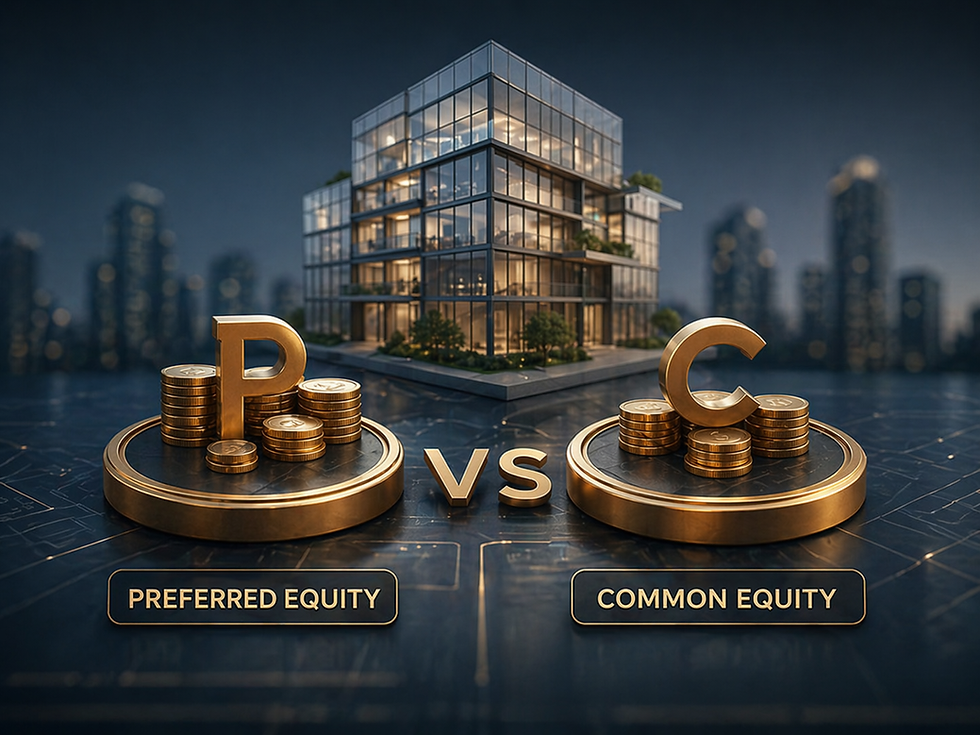
If you have spent any time studying commercial real estate deals, you have probably come across the term preferred equity in real estate. But what does it actually mean? And how is it different from common equity? These two forms of equity sit in the same capital stack, but they work very differently, and understanding the difference can completely change how you approach a deal, whether you are a sponsor raising capital or an investor deciding where to put your money. This guide breaks it all down in a clear and practical way so you can make better decisions on your next transaction.
What Is the Capital Stack and Why Does It Matter?
Before diving into the difference between preferred and common equity, it helps to understand where both of them sit in a commercial real estate deal.
Every commercial transaction is funded by a combination of debt and equity. The way these funding layers are organized is called the capital stack. At the top of the stack, you have senior debt, the safest position, paid back first, lowest return. At the bottom, you have common equity, the riskiest position, paid back last, with the highest potential return.
In between, you often find mezzanine debt and preferred equity. These middle layers carry more risk than senior debt but less risk than common equity. They also offer higher returns than debt but lower upside than common equity.
Understanding where each layer sits and what it means for risk and return is essential for any serious real estate investor or sponsor.
What Is Preferred Equity in Real Estate?
Preferred equity is a form of ownership in a real estate deal that comes with a priority return. This means preferred equity investors get paid before common equity holders receive anything but after all debt obligations have been met.
Here is how it typically works. A preferred equity investor agrees to provide capital in exchange for a fixed or minimum preferred return usually somewhere between 8% and 12% per year, depending on the deal and market conditions. This return is paid out before the sponsor or common equity partners see any distributions.
In many structures, preferred equity also comes with accrual features. If there is not enough cash flow to pay the preferred return in a given period, it accrues and must be paid back before any other equity distributions are made.
Preferred equity is particularly common in value-add and transitional deals, where cash flow may be limited in the early stages but the long-term upside is strong.
Key Features of Preferred Equity
Priority of return. Preferred equity investors receive distributions before common equity holders. This makes it a safer position in the equity stack.
Fixed or minimum return. Most preferred equity structures come with a defined preferred return, giving investors predictability on at least a portion of their yield.
Limited upside participation. In many structures, preferred equity investors do not fully participate in the upside beyond their preferred return. Once they receive their return and their capital back, the remaining profit goes to common equity.
Protective rights. Preferred equity investors often negotiate certain protective rights such as the ability to step in and take control of an asset if the sponsor defaults on their obligations.
What Is Common Equity in Real Estate?
Common equity is the ownership position that carries the most risk and the most potential reward. Common equity holders are last in line to receive distributions and last to be repaid in the event of a sale or refinancing.
In most commercial real estate deals, the sponsor contributes common equity either their own capital or capital raised from co-investors. This is the position that absorbs losses first if things go wrong, but it is also the position that captures all of the upside once preferred returns and debt have been satisfied.
Key Features of Common Equity
Highest risk, highest reward. Common equity sits at the bottom of the capital stack. It absorbs losses first but captures the most upside in a successful deal.
No guaranteed return. Unlike preferred equity, common equity holders have no guaranteed distribution. Their return depends entirely on the performance of the asset.
Control and decision-making. In most structures, common equity, specifically the sponsor, retains control over day-to-day decisions, asset management, and exit strategy.
Full profit participation. Once all debt and preferred equity obligations are met, common equity holders receive the remaining profits. In a strong deal, this can generate outsized returns.
Preferred Equity vs Common Equity: A Side-by-Side Comparison
Feature | Preferred Equity | Common Equity |
Risk level | Moderate | Highest |
Return type | Fixed/preferred return | Variable/residual |
Upside participation | Limited | Full |
Payment priority | Before common equity | Last |
Control | Limited | Full (sponsor) |
Position in capital stack | Middle | Bottom |
Typical return target | 8% – 12% preferred | 15% – 25%+ IRR |
If you want a deep breakdown of how these deals are actually structured in practice, including waterfalls, accruals, and investor protections, check out our Preferred Equity Structuring Guide.
When Do Sponsors Use Preferred Equity?
Sponsors turn to preferred equity for several reasons. The most common is to fill a gap in the capital stack. When senior debt does not cover the full amount of capital needed for a deal, and the sponsor does not want to bring in a full joint venture partner, preferred equity can bridge that gap.
It is also used to limit dilution. Bringing in a joint venture partner typically means giving up a significant share of the deal's profits. Preferred equity, on the other hand, has a capped return, which means the sponsor retains more of the upside once the preferred return has been paid.
Another reason sponsors use preferred equity is speed. Preferred equity investors often move faster than institutional joint venture partners, which can be critical in competitive deal environments where timing matters.
When Do Investors Choose Preferred Equity?
From an investor's perspective, preferred equity offers a middle ground between the low returns of debt and the high risk of common equity. It is an attractive option for investors who want more yield than a loan would provide, but who are not comfortable taking on full common equity risk.
Preferred equity is particularly popular with family offices, high-net-worth individuals, and smaller institutional investors who want exposure to commercial real estate returns without taking on the full downside risk of a common equity position.
It is also used by investors who want a more predictable income stream. The fixed or minimum preferred return provides a degree of visibility that pure equity positions do not offer.
Risks to Understand in Both Structures
Neither preferred equity nor common equity is without risk. Understanding those risks clearly is essential before committing capital to any deal.
For preferred equity investors, the main risks are deal performance and sponsor quality. If the asset underperforms significantly or if the sponsor runs into financial difficulty, even preferred equity can face losses. The protective rights that come with preferred equity structures help mitigate this, but they do not eliminate risk.
It is also worth noting that preferred equity is less liquid than publicly traded investments. Capital is typically locked up for the duration of the deal, which can range from two to five years or more.
For common equity investors, the risks are more direct. This position absorbs losses first and has no guaranteed return. In a deal that does not perform as projected, common equity holders may receive little or nothing.
This is why the quality of the sponsor their track record, market knowledge, and execution ability matters so much in common equity investments.You are not just investing in the asset. You are investing in the team behind it.
How These Structures Fit Into a Broader Investment Strategy
Whether you are a sponsor structuring a deal or an investor deciding where to allocate capital, understanding how preferred and common equity work together is essential for building a balanced real estate investment strategy.
For sponsors, the goal is to build a capital stack that minimizes the cost of capital while retaining as much upside as possible. This means being thoughtful about how much preferred equity you bring in, what return you offer, and how that affects your own common equity returns.
For investors, the goal is to find the right balance of risk and return for your specific situation. Preferred equity can be a powerful tool for generating consistent, above-debt returns with a degree of downside protection. Common equity offers the potential for higher returns, but requires a higher risk tolerance and a deeper level of conviction in the deal and the sponsor.
The most sophisticated real estate portfolios often include exposure to both using preferred equity for more defensive positions and common equity for higher-conviction opportunities where the upside justifies the risk.
The Role of a Capital Advisory Firm in Structuring Equity
Getting the equity structure right in a commercial real estate deal is not always straightforward. The terms, protections, and return structures can vary widely depending on the deal, the market, and the parties involved.
This is where working with an experienced capital advisory firm can make a significant difference. A good advisor does not just help you find capital. They help you structure it in a way that works for your specific deal balancing the needs of debt providers, preferred equity investors, and common equity holders in a way that is fair, executable, and aligned with your long-term goals.
For sponsors, this means going to market with a well-structured deal that attracts the right capital partners at the right terms. For investors, it means having a trusted advisor who can help evaluate opportunities and ensure that the structures they are investing in are sound.
Final Thoughts
The difference between preferred equity and common equity in real estate comes down to one core trade-off: risk versus reward. Preferred equity offers more protection and a predictable return, but limits your upside. Common equity takes on more risk, but gives you the full benefit of a deal that performs well.
Neither is inherently better than the other. The right choice depends on your goals, your risk tolerance, and the specific deal in front of you.
What matters most is that you understand exactly what you are getting into and that the structure of the deal reflects a clear, well-thought-out capital strategy.
Ready to Structure Your Next Deal?
Whether you are a sponsor looking to raise equity capital or an investor evaluating a structured real estate opportunity, getting the capital structure right from the start is critical.
Book a Call with the Quantum Growth team today. We work with sponsors and investors across commercial real estate markets to structure, advise, and execute capital solutions that are built for results.


Comments