
Preferred Equity Investment in Real Estate
Mar 23
3 min read
Updated: Mar 29
In today’s complex real estate market, preferred equity investment has emerged as a strategic financing solution. As traditional lending tightens and capital stacks become more sophisticated, developers and investors increasingly rely on this hybrid structure to bridge funding gaps, enhance returns, and manage risk.

Preferred equity sits between debt and common equity, providing investors with secured payouts while retaining exposure to project upside. Unlike passive equity, it is an active tool used to optimize deal economics, maintain control, and ensure downside protection. Institutional sponsors leverage preferred equity investment to structure resilient and profitable portfolios.
Understanding Preferred Equity Investment
A preferred equity investment represents a subordinated ownership interest in a real estate project. Investors receive priority over common equity holders for distributions but remain junior to senior debt.
In a typical arrangement, repayment proceeds follow this sequence: senior lenders, preferred equity investors, and then common equity holders. This hierarchy informs both risk allocation and expected returns.
Preferred equity investors trade limited governance for structured income and contractual rights, such as consent over material changes, takeover provisions, and participation in project profits through equity kickers.
Preferred Equity within the Capital Stack
The capital stack defines the repayment hierarchy and risk distribution in real estate finance.
Senior Debt
Senior debt forms the base of the stack. It benefits from first-position security against the asset, producing low-risk, predictable returns.
Mezzanine Financing
Mezzanine financing occupies the layer above senior debt. It carries higher risk and offers greater yield. Structurally, mezzanine debt may include equity pledges, intercreditor agreements, or conversion features to enhance investor protections.
Preferred Equity
Preferred equity bridges debt and common ownership. Investors receive fixed or structured returns and may participate in upside through performance incentives or equity kickers.
Common Equity
Common equity absorbs residual risk but retains full exposure to the upside. These investors bear the highest potential loss yet enjoy the greatest upside in successful projects.

Advantages of Preferred Equity Investment
Preferred equity investment is increasingly favored for its asymmetric risk-return profile:
7-12% current yield: Provides contractual cash flow that supports predictable income streams.
10-15% total IRR: Performance-based returns enable participation in project appreciation.
Downside control: Legal provisions allow investors to intervene if sponsors fail to meet obligations, ensuring structural protections.
Historical Trends in Preferred Equity
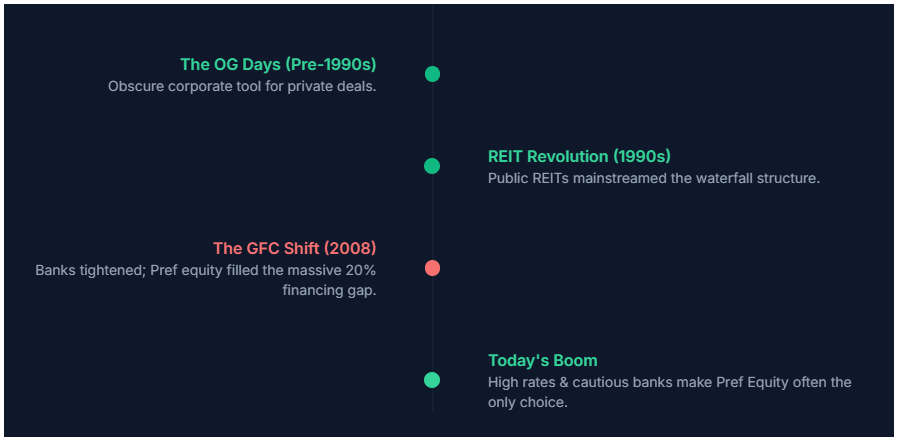
Hard vs Soft Preferred Equity
The structure of a preferred equity investment determines both risk and flexibility.
Hard Preferred Equity
Hard preferred equity imposes strict payment obligations. Distributions follow a defined schedule, and missed payments trigger default provisions. This resembles subordinated debt, providing strong downside protection but limiting operational flexibility for sponsors.
Soft Preferred Equity
Soft preferred equity allows payments to adjust based on available cash flow. This flexibility enables sponsors to navigate early-stage or underperforming projects while offering investors enhanced upside participation through equity kickers or profit-sharing clauses.
Market Dynamics Driving Preferred Equity Investment
Maturing Debt Portfolios
Significant real estate loan maturities by 2026 have created refinancing pressure. Sponsors increasingly use preferred equity investment as a bridge to recapitalize assets and avoid distressed sales.
Investor Sentiment
Institutional investors perceive preferred equity as a hybrid strategy that delivers equity-like returns with the downside protections typical of debt. This perception continues to attract capital into the segment.
Strategic Applications
Preferred equity serves multiple roles:
Recapitalization and rescue financing: Stabilize projects during cash shortfalls.
Liquidity optimization: Allows sponsors to access capital without divesting ownership.
Acquisition funding: Supports portfolio expansion while minimizing dilution.
Risks and Considerations
While preferred equity investment offers advantages, it carries structural and legal risks:
Legal classification risk: Courts may treat preferred equity as debt, thereby altering repayment priority.
Timing constraints on enforcement: Investor rights may be delayed due to disputes or intercreditor provisions.
Subordination exposure: Senior lenders have priority in foreclosure, which may limit recovery.
Restrictive covenants: Intercreditor agreements may restrict investors' actions during critical events.
Future Outlook
The role of preferred equity investment is expanding as capital markets evolve:
Digital structuring: Tokenization enables fractional ownership and secondary trading, improving liquidity.
Layered capital strategies: Preferred equity combined with mezzanine debt optimizes leverage while protecting downside.
Resilient asset classes: Multifamily and industrial properties remain primary targets due to steady demand and income predictability.
Property repositioning: Converting office assets into residential or mixed-use developments is increasingly funded through preferred equity.
Preferred equity investment has transitioned from a niche instrument to a cornerstone of modern real estate finance. It offers structured returns, downside protection, and strategic control.
Developers use it to secure flexible capital while preserving ownership economics. Investors gain contractual income, enhanced upside participation, and structural safeguards.
As markets evolve, preferred equity will continue to define how efficient, resilient, and profitable real estate deals are structured.


Comments