
How to Layer Debt and Equity for a CRE Deal
Apr 27
6 min read
One of the most critical skills any sponsor or investor needs in commercial real estate is knowing how to layer debt and equity for a CRE deal in a way that is both efficient and executable. Getting this right can mean the difference between a deal that generates strong returns and one that struggles from day one. The capital structure you build around a transaction affects everything: your cash flow, your risk exposure, your relationship with capital partners, and ultimately your profit at exit. In this guide, we will walk through how experienced sponsors approach this process and what you need to know before putting your next deal together.
Why the Layering of Capital Matters So Much
In commercial real estate, no two deals are funded the same way. Each transaction has its own risk profile, its own cash flow dynamics, and its own timeline. This is why the way you layer capital debt on top, equity below, has to be thoughtful and deal-specific.
A poorly structured capital stack can create real problems. Too much debt means high debt service that squeezes cash flow. Too little debt means leaving returns on the table. Bring in the wrong equity partner and you may find yourself in conflict over the business plan. Bring in too expensive a preferred equity tranche, and your common equity returns may not justify the risk.
The goal is to build a capital structure that is lean, logical, and aligned one where every layer of capital is priced appropriately for the risk it takes on, and where all parties have a clear understanding of how they get paid.
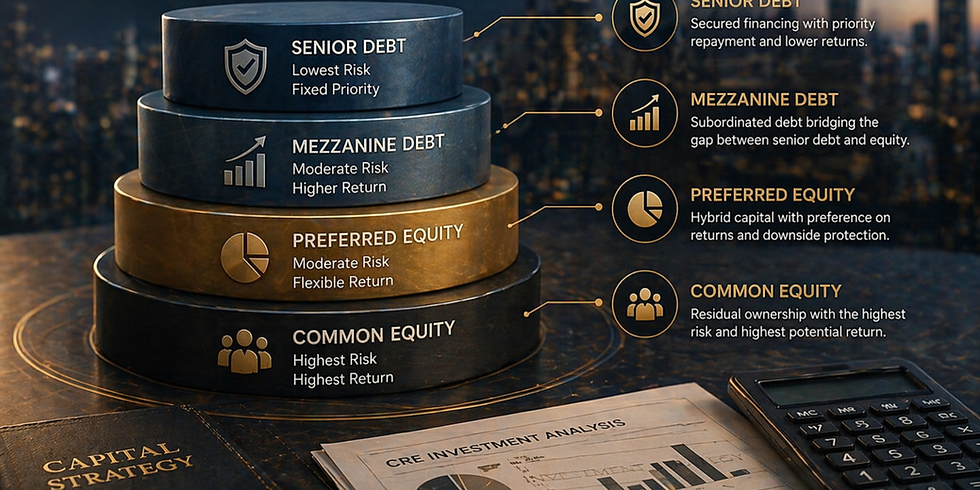
The Basic Layers of a CRE Capital Stack
Before you can layer capital effectively, you need to understand what the layers are and how they interact.
Senior Debt
Senior debt is always the foundation of a commercial real estate deal. It is the largest single source of capital in most transactions and carries the lowest cost because it sits in the safest position first to be repaid, first in line in the event of a default.
Senior debt can come from banks, life insurance companies, debt funds, CMBS lenders, or agency lenders like Fannie Mae and Freddie Mac for multifamily assets. Each lender type has different requirements, different pricing, and a different appetite for risk.
For sponsors, the right senior lender depends on the asset type, the business plan, and the deal timeline. A stabilized office asset may work well with a bank loan. A value-add multifamily property may be better suited to a bridge lender who can accommodate the transitional period.
Mezzanine Debt
Mezzanine debt sits just below senior debt in the capital stack. It is a form of subordinate financing that allows sponsors to increase their total leverage beyond what the senior lender will provide on its own.
Mezzanine lenders take on more risk than senior lenders, which is why they charge a higher interest rate. But for sponsors who need to bridge the gap between senior debt and equity, mezzanine financing can be a cost-effective solution particularly when the cost of mezzanine debt is lower than the cost of bringing in additional equity.
Preferred Equity
Preferred equity occupies the middle ground between debt and common equity. It is technically an ownership position, but it comes with a priority return that must be paid before common equity holders receive any distributions.
Preferred equity is particularly useful in deals where the sponsor wants to limit dilution. Rather than giving up a large share of the deal's upside to a joint venture partner, a sponsor can bring in preferred equity with a capped return and retain more of the profit at exit.
For a deeper look at how preferred equity compares to common equity and where each fits in a deal structure, it is worth reading our guide on Preferred Equity vs Common Equity in Real Estate.
Common Equity
Common equity sits at the bottom of the capital stack. It is the riskiest position the last to be repaid and the first to absorb losses — but it also captures the most upside in a successful deal.
Sponsors typically contribute common equity themselves, either from their own capital or through co-investors. In larger deals, a joint venture partner may come in at the common equity level, sharing both the risk and the reward.
How to Think About Leverage
Leverage is one of the most powerful tools in commercial real estate and one of the most dangerous if used carelessly. The right amount of leverage depends on the deal, the market, and the risk tolerance of the sponsor and their capital partners.
In general, higher leverage amplifies both returns and risk. A deal with 75% loan-to-cost financing will generate higher equity returns than the same deal with 60% financing but it also leaves less room for error if the asset underperforms or if market conditions shift.
Experienced sponsors think about leverage in terms of debt service coverage. The income generated by the asset needs to comfortably cover debt payments, even in a stress scenario. If your deal only works at full occupancy with no vacancy buffer, you are taking on more leverage risk than is prudent.
Understanding how to optimize the full capital stack not just the debt layer is essential for building deals that perform across different market conditions. For a comprehensive look at this, Read our guide on How to Optimize Capital Stack in CRE.
Matching Capital to the Deal Type
Different deal types call for different capital structures. Here is how experienced sponsors typically think about this:
Stabilized Core Assets: These are low-risk, income-producing properties with strong occupancy and predictable cash flow. They attract the most conservative capital long-term fixed-rate senior debt from life insurance companies or banks, with relatively modest equity requirements. The returns are lower, but so is the risk.
Value-Add Transactions Value-add deals involve properties that need some level of repositioning, lease-up, renovation, or operational improvement. These deals typically use bridge debt at the senior level, sometimes supplemented by mezzanine or preferred equity to fill the capital stack. The business plan requires more active management, and the capital structure needs to accommodate a transitional period before the asset reaches stabilization.
Development and Ground-Up Construction Development deals carry the highest risk and therefore require the most carefully structured capital. Construction loans, equity contributions, and often preferred equity or mezzanine debt all play a role. Timing is critical; the capital structure needs to be in place well before the project breaks ground.
Opportunistic and Special Situations: These are the highest-risk, highest-reward deals, distressed assets, complex recapitalizations, or special situation investments. They often require bespoke capital solutions that do not fit neatly into standard structures. Sponsors working on these types of transactions typically benefit most from working with an experienced capital advisor who understands the nuances of structuring complex deals.
Common Mistakes When Layering Capital
Even experienced sponsors sometimes get the capital structure wrong. Here are a few of the most frequent mistakes to avoid.
Stacking too much debt. High leverage feels attractive when markets are strong, but it creates fragility. If cash flow dips or the exit takes longer than expected, heavy debt service can become a serious problem.
Mismatching debt term and business plan. If your business plan calls for a three-year repositioning, you need debt that accommodates that timeline. Taking a short-term bridge loan on a deal that needs five years to execute is a recipe for a forced refinance at the worst possible time.
Underpricing preferred equity. Bringing in preferred equity at terms that are too aggressive can significantly erode common equity returns. Always model out the full waterfall before agreeing to preferred equity terms.
Ignoring alignment with equity partners. Whether it is a joint venture partner or a preferred equity investor, alignment on the business plan and exit strategy matters. Misalignment at the start of a deal almost always creates problems down the road.
The Value of Getting the Structure Right Early
The best sponsors do not wait until they are under contract to think about their capital structure. They start modeling the capital stack from the moment they begin underwriting a deal because the structure affects the returns, and the returns determine whether the deal makes sense in the first place.
Getting the structure right early also gives you more time to approach the right capital partners, run a competitive process, and negotiate terms from a position of strength. Sponsors who scramble to put together capital at the last minute almost always end up with worse terms than those who plan..
Working With a Capital Advisory Partner
For many sponsors, especially those working on larger or more complex transactions, partnering with a capital advisory firm is one of the best investments they can make. A good advisor brings market knowledge, lender and investor relationships, and structuring expertise that is genuinely difficult to replicate on your own.
The right advisor helps you build a capital structure that works for your specific deal, approach the right capital partners, and manage the process from term sheet to closing. This frees you up to focus on what you do best: finding and executing on great real estate opportunities.
Take the Next Step
If you are working on a commercial real estate transaction and want to make sure your capital structure is built the right way, we are here to help.
Book a Call with the Quantum Growth team today. We work with sponsors and investors across commercial real estate markets to structure and execute capital solutions that are designed for results.


Comments